Thursday, 23 May 2013

Star Trek - Kismet(?), Spock


One of the dominant tropes in modern storytelling is the love story. The hero needs his heroine, and vice versa. It’s not just a motivational device, but an actual core storytelling mechanism which is used for elements as diverse as curing or ameliorating mental illness (As Good As Garden State Gets In A Silver Linings Playbook) to saving the planet (The Fifth Element), to being the only thing necessary to having a happy life (most romantic comedies).

Of course, we’re talking heterosexual relationships. I’d argue that there are a few basic reasons why this boy-girl dynamic is so prevalent, and why it is more so in the late 20th / early 21st century than it has been at any other point, particularly with respect to action films and other traditionally “male” stories:

1) Freud
2) Increased cultural cross pollination where action films now need to appeal to both men and women
3) The general rise of and public acceptance of gay rights and homosexuality as a lifestyle choice

Let’s focus on the last point, because it’s the most immediately counterintuitive. Why would an increased outward acceptance of homosexuality result in more on-screen hetero relationships? Easy answer: because people are insecure. This, in turn, feeds back into the first point, because thanks to Freud, everything is now about sex.

If homosexuality is something which is pretty much kept behind closed doors, there’s no need to worry about how “gay” you (or the films, or characters you’re watching) look. However, if sexuality is a matter of public discourse, then you need to be sure that everyone out there knows that you’re a man! A man’s man! But not in a gay way, noooo sir. And likewise for the films you watch, and the characters you relate to.

Look at the action films of the ‘80s and ‘90s. The surge of gay rights awareness was followed by a transformation in action films, as the solitary, muscular pin-up protagonists of the Arnie / Sly era were replaced by the more ordinary-looking Willis and Cage-types of the ‘90s, who almost always had girlfriends or wives. It also works if you look at the shift from Republican to Democrat government, as essentially the more liberal the environment becomes, the more it becomes necessary to label yourself as hetero. 


An intimidating bad guy from the ‘80s

For a more concrete and longer term look at how attitudes have changed, take a look at this, er, interesting collection of turn of the century pictures from http://www.artofmanliness.com/2012/07/29/bosom-buddies-a-photo-history-of-male-affection/.


The men who appeared in those pictures just didn’t care about appearing gay, and non-sexual physical affection between dudes is one of the things which has fallen by the wayside in a world where most straight men are constantly trying to affirm just how straight they are.

Popular entertainment-wise, some of the elements which have fallen out of favour are that of the bachelor, and that of the male-male friendship. Single male pairings like Holmes and Watson are essentially a thing of the past, and modern retellings (House, or the Downey Jr. movies) make sure that they are exposed to sufficient amounts of willing poon.

Even this level of friendship generally leads to fervent speculation about whether the characters are sequestering secret, all-consuming sexual passions for one another. In one of the few modern blockbusters without any kind of real hetero love story at its core, there’s been an awful lot of speculation about Sam and Frodo.

The answer for these questions is generally a tired “no,” or at best a “I guess, if you like.”
The emotion displayed by Sam at Mount Doom in the third Hobbit film can be fairly well explained by the fact that it is a film of a kid’s book (sorry Tolkien fans) and that’s how those guys roll. In addition, LoTR is possibly one of the most asexual large scale fictional universes I’ve ever encountered, and even then the writers go out of their way to show Sam exchanging shyly amorous glances with a Hobbitess somewhere in the interminable final 8 hours of the last film. As if anyone cared.  Frodo sure doesn’t.


This is similar to what happens with House and Watson, or Harry and Ron (? Is this a thing? I’m not looking it up). There is just zero sexual tension there, unless you really want to read it in. The smartest thing most writers can do is at least leave a few elements ambiguous or undefined, because you don’t necessarily want to alienate a large portion of your audience by crushing their / slash based dreams.

Still, like the Sam / Frodo example, any ambiguity is generally countered with hetero box ticking. In literally the only example of one of these “are they, aren’t they” questions actually getting resolved, the protagonist slept with her long-standing female sidekick in the finale of tacky swords’n’sandals series Xena: Warrior Princess, and was promptly (and hilariously) decapitated. I tried to look this up, and embed it, but I can't find a version which doesn't have Creed or derivatives thereof playing over the top, and frankly, this article is making my internet history look weird enough as is. 

One of more famous surviving screen pairings is that of Spock and Kirk, that brings us to Star Trek, and more specifically, Star Trek into Darkness.


J J Abrams: “I like this poster… can we have more lens flare?”

As a quick summation of the film, it’s basically what you’d expect, and maybe even a touch better. There’s a lot (a metric shit ton) of lens flare, some really pointless personal development decisions (Kirk loses his captaincy for about… 7 minutes of the film?), and it employs one of the most overused devices in modern cinema.


The worst part about this particular storytelling device is that it never makes any sense. I understand that thematically it demonstrates the villain’s power by showing that it’s undiminished by captivity and whatnot, but does the actual plotting behind it have to be so stupid? Every time?

Anyhoo, the film is quite entertaining in its own silly way. Matters get resolved with a somersault choke slam, and high quality finishing moves always bump up films by at least one hypothetical star for me. The combination of the confusing plot and the slick iPad veneer of the film can make it difficult to relate to- in particular, Chris Pine’s Kirk and Alice Eve’s Whoever This Character Was are archetypal cornfed clones from the Hollywood gene-banks, and any attempted gravitas just reflects harmlessly off their blemish-free surfaces.  Maybe that’s what’s causing all the lens flare. There’s a muscular, black, bald woman on the bridge of the Enterprise who stands out of the entire franchise like a sore thumb, proving that the inclusion of a human with a different body type is more shocking than any superficially made-up alien.

But sod all that. 

How gay was this film, and specifically, Kirk and Spock’s relationship?

With all of my previous ramble, you could be forgiven for expecting me to say how any kind of  “bromantic” undertones are massively exaggerated, and we need to get away from this kind of oversexualised reductive thinking and etc etc.

But no. It’s actually… pretty gay?

Star Trek itself is obviously based on the ancient story of the ship of heroes visiting strange lands, as in the Odyssey, or Sinbad. It’s also at least partially based on the concept of the more modern navy which, unsurprisingly (men trapped together for months on end) has had


associations.

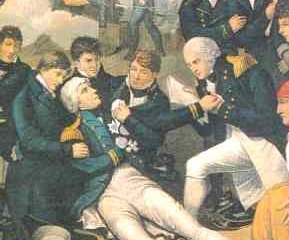
One of the most famous and contentious historical assertions of male love was the death of the British Admiral Nelson. The story goes, that as he expired on board his ship, he uttered the words “Kiss me, Hardy,” to one of his officers.


This has been refuted by claims that he said “Kismet, Hardy,” (which means fate), and counter-refuted by claims that “kismet” wasn’t in use back then, counter-counter refuted by claims that it’s all a misquotation and he never said anything of the sort, and counter-counter-counter-refuted by claims that he probably did actually say “Kiss me, Hardy”, but not when he was dying. Because finding out where one of Britain’s greatest heroes (most likely a bit of a prat and/or a psychopath in actuality) liked to put his penis is important.

**********************SPOLIER WARNING SPOLIER SPOLIER THIS WILL TELL YOU WHAT HAPPENS IN THIS FILM IT’S FUNDAMENTALLY PRETTY PREDICTABLE ANYWAY STOP READING NOW IF YOU DON@T WANT TO HAVE IT RUINED ROSEBUD IS A SLED AND BRUCE WILLIS IS DEAD IN CASE YOUR STILL READING SPOLIER SPOLIER ***************************************

Towards the end of the film, Kirk is dying from radiation poisoning, and Spock finds him trapped behind the glass in the reactor lock. Kirk tells Spock that he’s scared, and asks Spock how to stop feeling, and Spock tells him that he doesn’t know how.

Then, Kirk (weeping) says something like: “I need to tell you why I went back for you.”
Spock (weeping): “Because, you are my friend…”
And then they mind meld (?) through the glass, and Kirk is about to say something more, and then he dies.

Now, if we’re a writer and we’re making sure to keep our shit ambiguous, it certainly qualifies. However, unlike most of our previous examples, this one felt a little different, for two basic reasons. Firstly, Spock finishes Kirk’s question for him – we don’t actually hear what Kirk was going to say, and “because you’re my friend” is both anodyne and redundant information anyway. We know Spock is Kirk’s friend.Secondly, Kirk is about to say something else as he dies, the implication being that he needs to say more, or something beyond friendship. This tilts our ambiguometer pretty significantly in one direction, at least in my book.

In all, I thought this scene was pretty cool. It implies that there’s a bit more to Kirk beneath the bro-ey  surface, it’s actually taking a bit of a risk with a franchise which is can occasionally give the impression of being written by money powered robots, and it was a moment of actual emotion.

If I had to bring it back to the ol’ liberalisation explanation, I’d argue that this kind of thing is starting to appear in popular culture because we are actually seeing the effects of a more liberal society, where people are aware of homosexuality but don’t feel as threatened by it as they once did.

Take a look at Javier Bardem’s character in Skyfall. Bond’s biggest superpower hasn’t ever been that he’s particularly good at shooting or judo chopping people. It’s that he’s so charming that even his enemies can rarely bring themselves to (directly) kill him, and certainly not without trying to impress him with their plans. Bardem’s character, or the first male antagonist who has actually demonstrated real attraction towards Bond, represented one logical extension of that.

Anyways, it’s always interesting when mainstream moneyspinners confront relatively sensitive subjects, so just like Django and racism, I thought I’d stick my oar in.

...

BUT NOT IN A GAY WAY.


Friday, 25 January 2013

Django Unchained Review


Long Ass Film Gets Long Ass Review


SMART DUM FILMS


If you haven’t seen Django Unchained yet, here are three takeaways:

1)      It’s pretty good
2)      It’s very violent and is definitely not for the squeamish
3)      It’s  long. At seven hours in length, it’s still four hours shorter than Jackie Brown. Regardless, you’ll need buttocks of steel.

 Django Unchained is Quentin Tarantino’s latest film, and one of his best for a while. The titular Django (Jamie Foxx) is a slave in the American Wild West who is freed and sets out to become a gunslinging bounty hunter and rescue his lost wife.


Ever since Verhoeven (and probably before that), filmmakers have been wrapping ostensibly silly films around serious issues and concepts.  The closest of these to Django Unchained is probably Robert Rodriguez’ Machete. Both films feature an ethnic protagonist confronting a racist side of America which is rarely seen in popular modern cinema, as viewed through a lens of retro ‘70s ultraviolence. The differences in the films make a decent reflection of the filmmakers themselves –Rodriguez has always seemed a bit more comfortable in his own skin, a guy who has no real issues making “Spy Kids” for his children. Tarantino is a lot more grandiose, but also insecure in his fear of not being seen as a great director. So, Machete is less ambitious, and lacks Django’s sprawl and ability to evoke emotion, but is probably a little more consistent and fun.

INVERSIONS


Django Unchained is Tarantino’s second crack at a film focused on African Americans, the first being the aforementioned Jackie Brown, which felt like a young filmmaker’s attempt to test himself with a steady, understated drama. Django is much more of an archetypical Tarantino flick - quick, edgy, a whirlwind of influences, styles, dialogue and violence. For better or worse, Tarantino has settled into his role as a remix artist of popular culture.  

Right from the beginning, he sets out to surprise. This isn’t only accomplished through the characters, but through the music and even the cinematography. The first fifteen minutes are in the sombre earth tones of the western, complete with winkingly retro opening credits. After Django gains his freedom, there’s a sudden burst of colour- he buys himself an outlandishly garish blue suit, and the change is reflected in his surroundings as he rides through a field of vibrant green to a pure white house. Not only is it emphasizing the sense of release, but it makes the viewer realize how rarely they see colours like this in a film like this. Likewise, the soundtrack throws its own curveballs, when Country and Western unexpectedly gives way to Rick Ross and Tupac.


The film is about race, and it’s with the characters and their expected roles that it makes its biggest twists. Django, as mentioned by others, is a black man who has taken on the mantle of two of the biggest white heroic archetypes – the cowboy, and the Nordic hero Siegfried. Germans in cinema are almost always Nazis (unless the film is from the 80s or 90s, in which case they’re terrorists), but his mentor / friend Schultz (Christopher Waltz) is essentially the only non-bigoted white and the primary articulator of the film’s arguments against slavery.


 The villains are more subtle – DiCaprio’s Candie, a viciously brutal plantation owner, is revealed over the course of the film to be almost entirely shaped by the black men around him, from the slave who raised him, to his manservant, to his manipulation by Django himself. Speaking of the manservant, Samuel L Jackson has himself a whale of a time playing a black caricature inside and within a film of broad brush, larger than life personalities. To give away more would ruin it, but he stands out as the most interesting and complex figure of the movie.

VIOLENT


Subtext doesn’t necessarily make for a complicated film though, and Django is pretty straightforward. It doesn’t really have anything to say about the subtleties of race relations beyond “Slavery bad. Violence towards slavers good.”

It is an extremely violent film, although something interesting is the two separate ways the violence is handled – when atrocities are being inflicted on the black slaves, there is generally little in the way of gore. Instead, the suffering is largely brought across through sounds – screams, cracks, grunts. What little blood there is is darker and more realistic than the bright corn syrup which spatters the rest of the film. These scenes can often be profoundly disturbing.  Conversely, when Django is mowing down evil crackers, they don’t so much bleed as comically explode in cathartic fireworks of viscera.

The Caucasian circulatory system is a strange and wondrous thing

 It’s this ability to mix and match which is inseparably Tarantino’s strength, and something which can get a little irritating. He often attempts to crowbar in a too much in terms of influence and tone into his films (“I saw this and it was super awesome so I put it in my film! And this! And also this!”) just to prove that he can. 

Django is certainly a hell of a lot less annoying than the Kill Bill films in this respect, but it can still feel uneven. A broad comic scene with a Klan lynch mob is actually pretty funny, but sits ill with the rest of the film as a whole. The third act drags and slows the film’s pace. The sheer length of the movie of it allows Tarantino to indulge his love for vignettes, but pulls away from the grindhouse sensibilities of being taut and economical. Want to make a movie which is touching and touches on real life issues, which shows the comical and the brutal sides of violence, which has slapstick and characterization and drama? Well, you just can’t and maintain your focus.

RACIST


Is the film racist? No, of course it’s not. It violently hammers home what is a clearly anti-racist message.  What it in fact is, is tasteless. And that’s ok. Doesn’t even make it a bad film. Lots of good and even great films have been pretty tasteless.

Much of the brouhaha surrounding it came from Spike Lee’s reactions to the film, where he described it as “disrespectful.” This, in itself, is not surprising. Spike Lee and Quentin Tarantino have had a well-publicised feud which goes back years, and it’s not even difficult to see why. Tarantino does not exactly paint subtle portraits when he makes his films, and he likes writing about black people. Spike Lee is fairly sensitive when it comes to portrayals of blacks in modern media, and largely with good reason.  In addition, there’s the issue of street cred, where Tarantino is a middle class white kid, and Lee is not.

                      Still a pretty accurate summation of these two dudes over ten years later

                More than that, however, I would guess that the enmity between the two of them stems from their similarities, rather than their differences. In the natural world, the greatest threat comes from a species’ ecological niche being invaded, and the same is true of people in their personal or professional lives.  If someone just like you gets introduced into your friendship group or workplace, you will almost certainly find yourself fighting off an irrational surge of dislike (you’ll probably also be incapable of recognising how similar they are to you). 

Fear your respective Lesters and Elizas. They are out to get you.

We all have a couple of friends whose massive similarity to each other has resulted in an everlasting enmity, and unintentionally comical wars on Twitter and/or Facebook. Well, some of us do. Anyway, Tarantino and Lee were both relatively young, nerdy directors who write about crime and the street, who love dialogue and, yes, racist invective. Were they ever going to like each other?

Speaking of invective, the bulk of criticism is generally levelled at Tarantino’s constant use of the “N” word in the film. Tarantino has defended this by claiming that he’s just using it in the name of historical veracity. This argument of course falls down when people are using the word “fuck” and other anachronistic swearwords in a film set in the mid 1800s. The fact is, Tarantino is a nerd, and he obviously gets a lot of pleasure out of using naughty words in front of lots of people like a bad ass. Tasteless, yes. Racist, probably not.

As a matter of fact, if there is an analogue for Tarantino himself in the film, it is certainly Calvin Candie: the rich white boy who makes the violence happen for his own amusement, an awkward geek trying to be cool and cultured at the same time, and the only character who gets a rambling Dorkologue as is so characteristic of Tarantino and his '90s contemporaries (notably Kevins Williamson and Smith). Spike Lee doesn’t need to hate Tarantino. The guy made the most repulsive character in his film resemble himself more than a little bit. 

 What racism there is in Django Unchained is also present in several of Tarantino's other works. Finding racism in it is much like finding misogyny in Bond films - of course you can find it there if you want to, but you could really be spending your time doing something more productive. There are other, more genuinely racist films out there (the recent short "Punisher: Dirty Laundry" for example). In addition, the fact that both Jackson and Foxx give arguably give the most multifaceted and interesting performances of the film yet have been completely ignored by the Academy in favour of DiCaprio and Waltz certainly feels odd. Try putting Django Unchained into google image search and see how many pictures of Foxx himself actually come up as opposed to DiCaprio.

There is, however, one group of people which will be be justifiably offended by one of the atrocities in the film. I am, of course, referring to Australians. Tarantino once again attempts to act in the film, and produces an Australian accent that has to go down in history alongside Kevin Costner's English or Christopher Lambert's Scottish (below) as one of cinema's worst.


                                                           You stupid haggis

All said and done, it's a Quentin Tarantino film, albeit a very good one, and it comes with the relevant strengths and weaknesses. It's smart and literate. It can feel soulless at times (although much less so than most of his other flicks). It's very exciting. The boss battle is a tad unsatisfying. The main actors all knock it out of the park. Enjoyment levels will be dependent on how much you enjoy references. Racial slurs. Violence. 

Sound good? Go watch it then. 


Monday, 7 January 2013

The Impossible Review


Tasteless? Sort of, but only as a function of narrative veracity. Or something.  Spoilers.

 
This guy does not appear in the film

The Impossible is a film based on a true story about the 2004 Indian Ocean Tsunami, as seen through the eyes of one western family on holiday in Khao Lak, Thailand. The original Spanish family have been racebended to a more box office-palatable English / Scottish group, with the primary cast being Ewan Macgregor, Naomi Watts, and Tom Holland (who appears to be a young clone of Jamie Bell).

The early parts of the film are handled in a workmanlike, even predictable manner. We’re introduced to the family on the plane, they arrive in the resort, shots of the placid ocean are given menacing, Jaws-esque music.

When the wave itself actually hits, it’s a whole different ball game. There’s very little build up, no shots of it rushing across the beach. A blender in the hotel dies, some trees in the background fall, and suddenly a wall of water smashes into the protagonists  and everyone around them.


The violence of the wave itself is shockingly realistic, and preconceptions of simply having to fight against a surge of clean seawater are quickly smashed. It is filthy brown, and filled with branches and debris which bludgeon and tear at its victims as it tosses them around like a washing mashine.When it is eventually over, the survivors must find their way back to each other through the shattered remnants of the Thai coastline.


Much has been made of the ethnic bias of the film, and it is true that most of the characters are white, and/or western. The Thai people do appear, but only generally as background, or plot devices to ferry the main characters from one section to another. Few of them are even seen dead, injured or suffering. Given the massive casualties suffered by the Thai people, it seems callous at worst and manipulative at best. But, is it actually that unlikely?


Here is where the film’s greatest selling point (that it is “true”) starts to become its own undoing. From the perspective of a foreigner in a strange land, the people around just can’t have that much bearing on your own story. You can’t converse with them, and interactions must be fairly limited, particularly if there are also a group around you which speak your lingo. You will just naturally gravitate to them. Similarly, in the heart of Khao Lak, there probably were a lot more tourists around the area than there were native Thais. It’s entirely possible that the ethnocentric bias is simply a side effect of having the perspective coming from a relatively wealthy, prosperous western family on holiday. Adding more Thai into the narrative may, oddly enough, have detracted from its veracity. It might have made a better or at least more ethnically tasteful film, but would it have been a "truthful" one?

The Impossible often feels a little uncomfortable in its own skin. Ostensibly a disaster movie, its antecedents are closer to the flicks where an individual fights through personal horror and suffering to salvation, such as Touching The Void and 127 Hours (or to go a bit further afield, The Passion of the Christ or even Saw). A salient difference is that Watts, as the primary sufferer, is a woman, and it’s one which director Juan Antonio Bayona is clearly aware of. A soft-focus shot of Watts pulling on her bikini early on in the film teases a glimpse of nipple, and is contrasted later on with a sudden, unexpected full on shot of her breast with a vicious slash across it. "You wanted to see tits? Well, here you go!" 


Any opportunity to show its characters (and particularly Watts) in pain is jumped on, with plenty of time spent with her screaming as she’s dragged across bamboo with an injured leg or trying to force herself to climb a tree. Macgregor by contrast gets off relatively lightly, but there’s still one unintentionally comical scene where he tries to climb a chair which collapses underneath him with an exaggerated grisly crack, and he screams like someone just stabbed him. 

The other difference between The Impossible  and 127 Voids is that in those films, the protagonist struggled against near-impossible odds with only supreme willpower to rely on. The main ability of the Impossible family is given away by the title – they are just super goddamn lucky. Their survival isn’t really due to any particular efforts on their parts, but on a confluence of bizarre chances.

Thus, as a disaster film, it focuses too much on the trials and tribulations of one privileged and wealthy family whilst ignoring the greater tragedy around them. As a Touching the Hours (let’s call them “Plato’s Mixed Pleasure Salvation” films because I feel like being a wanker) film, it does not have the necessary drive or progression from the characters that it is focusing on.

 Essentially, the family’s story just doesn’t quite work on a narrative level. If it were in a magazine article, or published online, it would be a fantastic read, and would probably blow up on Reddit. Taken as a longer tale, as either a book or a film, it doesn’t hang together because you can’t make an overarching story on the premise of “Family gets hit by tsunami, most people around them die, none of them do. What are the odds?!”, regardless of whether it's true or not. 

It is human nature to root for the underdog, and despite the grisly relish that The Impossible takes in depicting their agony, it’s difficult to think of the family as such.  They’ve already hit the jackpot in life by being rich, relatively happy and functional, and throughout the film, even through the screams and the crunches, I found myself being gobsmacked at their relative good fortune compared to those around them.

In the end, luck can make for good anecdotes, but making a story entirely about it? At the very least, it’s pretty improbable.  

Monday, 18 June 2012

Prometheus Review

Sequels and Prequels


After over 30 years away from the franchise, Ridley Scott finally returns to the world which made him famous. The result is a strange beast: a technically adept  film which adroitly sidesteps some of the potholes which other sci-fi franchises have fallen to, but ultimately fails to live up to its own goals.
From the opening scenes, Prometheus makes its intentions clear – this is to be no simple space action horror film! It explicitly states that it is going to be about subjects like the dawn of the human race, our purpose in the universe, and what God means to us. Weighty stuff. Once the introductions are past, however, we are back in familiar territory. A mismatched group of individuals wake up in a starship, and touch down on an alien planet where they encounter a deadly threat.

Dodging George Lucas' Phantom


The film manages to avoid one of the common pitfalls of the prequel, namely the tendency to drown the viewer in familiarity. The easiest offender in this case is, of course, Star Wars.

                   “Hey! Remember us from the original trilogy! We’re in the prequel for no reason at all”

Scott knows not to put too much stress on the film’s pedigree. Whilst the references to Alien are there (and they slowly build in frequency and intensity throughout the film), it thankfully doesn’t crowbar in xenomorphs as the primary threat, and therefore manages to keep the audience feeling like they are in uncharted territory. This is a smart move, from both a marketing perspective and from a narrative one- the third and fourth films in the series, followed by cash-grab tussles with the Predators, have rubbed a lot of the lustre off the Alien franchise in recent years, and the life cycle from face-hugger to chest-burster to xenomorph is now so familiar to most audiences as to be blasé.


                                                   Familiarity is the enemy of horror

Another issue with prequels is their tendency to answer questions from their progenitors which didn’t need answering. Returning to Star Wars as an example of “how NOT to do it”, remember how you found out that the Force was caused by “midichlorians?” It was stupid.

In this, Prometheus is a less qualified success. One of the many elements which made Alien such a tight thriller was its economy- you didn’t need to know exactly what had happened to the elephant aliens in the horseshoe ship at the beginning, any more than you needed subtitles for the Norwegian gentlemen in the helicopter at the beginning of John Carpenter’s The Thing. The aliens in the ship did a wonderful job of being a narrative iceberg, hinting at greater mysteries beneath the surface, that humans were only aware of one corner of a vast and unknown universe. Without giving too much away, it could be argued that Prometheus actually steps backwards and closes off some of that expansiveness. Rather than mankind being a small, ignorant part of the Aliens universe, it's now the focus.


Sequels


Whilst it is clearly a narrative prequel, Prometheus feels a lot like a thematic sequel. If Alien is a twisted metaphor for birth, then Prometheus is about the relationships between parents and their children.  There are echoes of this at every level of the script, from Naomi Rapace’s archaeologist protagonist and her dead father, to humanity itself and the aliens who supposedly created it. The theme is one of the more consistent and interesting elements running throughout the film, and is personified by Fassbender’s android, David, and his ambivalent relationship to his maker. Whilst ostensibly an earlier model than Alien’s Ash or Aliens’ Bishop, his character feels like a natural successor to both of them -  whereas Ash was basically “evil”, and Bishop was “good”, David is neither of these things, skirting closer to Blade Runner’s amoral Replicants. Occasionally some of the more melodramatic scripting veers him a bit towards the dreaded “vaguely camp sinister British guy” territory...

                                                                     "Fnar"

...but overall the character is just a blast as he wanders through the story, seemingly motivated almost entirely by his own curiosity.

Only a few of the cast other than David are filled out more to be than briefly sketched clichés, standouts being Rapace, her brash partner Marshall-Green, and Charlize Theron’s ice queen, but there are some nice twists and reveals in the relationships of the crew, and most of the character interactions are comfortable and assured, proving that Scott is still generally a dab hand at this kind of thing.  

The way that Prometheus attempts to expand and explain the universe established in the first film in such an ambitious way just feels like a director flexing their muscles, proving that they can not only make action or horror, but can tackle big themes. Alien and, more specifically, Blade Runner had interesting things to say about the human condition, but they were subtly hidden in well-constructed horror and noir films respectively. By putting the big ideas front and centre, Prometheus has two problems – that the shift of gears from philosophical discovery to the inevitable space action horror is somewhat jarring, and that the ideas which the film is talking about are simply too big to be directly handled. The film knows this, and so they aren’t ever really answered. However, the obvious downside to this approach is that it makes Prometheus a bit of a gyp, as it sidesteps its own grandiose claims.

When the action does happen it’s all well-handled and exciting, and the film is often absolutely beautiful to look at, with one notable exception being a vicious birthing scene (which only reinforces a sneaking suspicion that Ridley Scott has some pretty weird attitudes towards women).

                            This, the Thelma and Louise parking lot scene,  and GI Jane to be specific

Swiss Cheese


 In fact, it’s interesting to see a film which does so many things right in terms of action, direction, themes, and character but still doesn’t really quite work like it should. The last and biggest reason why it doesn’t is simply this: It just doesn’t make much sense. In tying together a film which still recognizably similar to Alien, and an Erich von Daniken version of 2010: A Space Odyssey, the film has a lot of holes. Like, a lot. If you watch it, afterwards ask yourself these questions for starters:

1)      Why would the aliens “invite” humanity to that particular planet?
2)      The crew of the Nostromo were believably unprofessional because they were just a bunch of blue collar working stiffs. What’s the excuse of the Prometheus cast?  
3)      If the alien ship still works, why is it still there?
4)      Did this whole situation get completely swept under the rug before Alien?

There are others, and some of these queries could presumably be answered by a sequel, but even ignoring the obvious problem that movies should ideally be self-contained, I’d lay money down that they won’t be, or that if they do that they won’t be particularly satisfying. It might seem hypocritical to criticize this seeing as earlier on I was lauding the way Alien kept some of its mysteries intact, but there is a difference between a mystery and an unresolved plot point - one of them is annoying, and the other isn't.

                                  The poster child for unanswerable questions and narrative blue balls

The end result is a film that is best enjoyed if you just switch your brain off. It has a lot of disparate elements which are fun and well-made in and of themselve, and it’s visually sumptuous. If you just let the references and action wash over you without questioning it, you’ll be entertained. If you go in expecting another science fiction milestone from Scott, you should probably get ready to be disappointed, or possibly even very angry, depending on how much of a geek you are, of course.